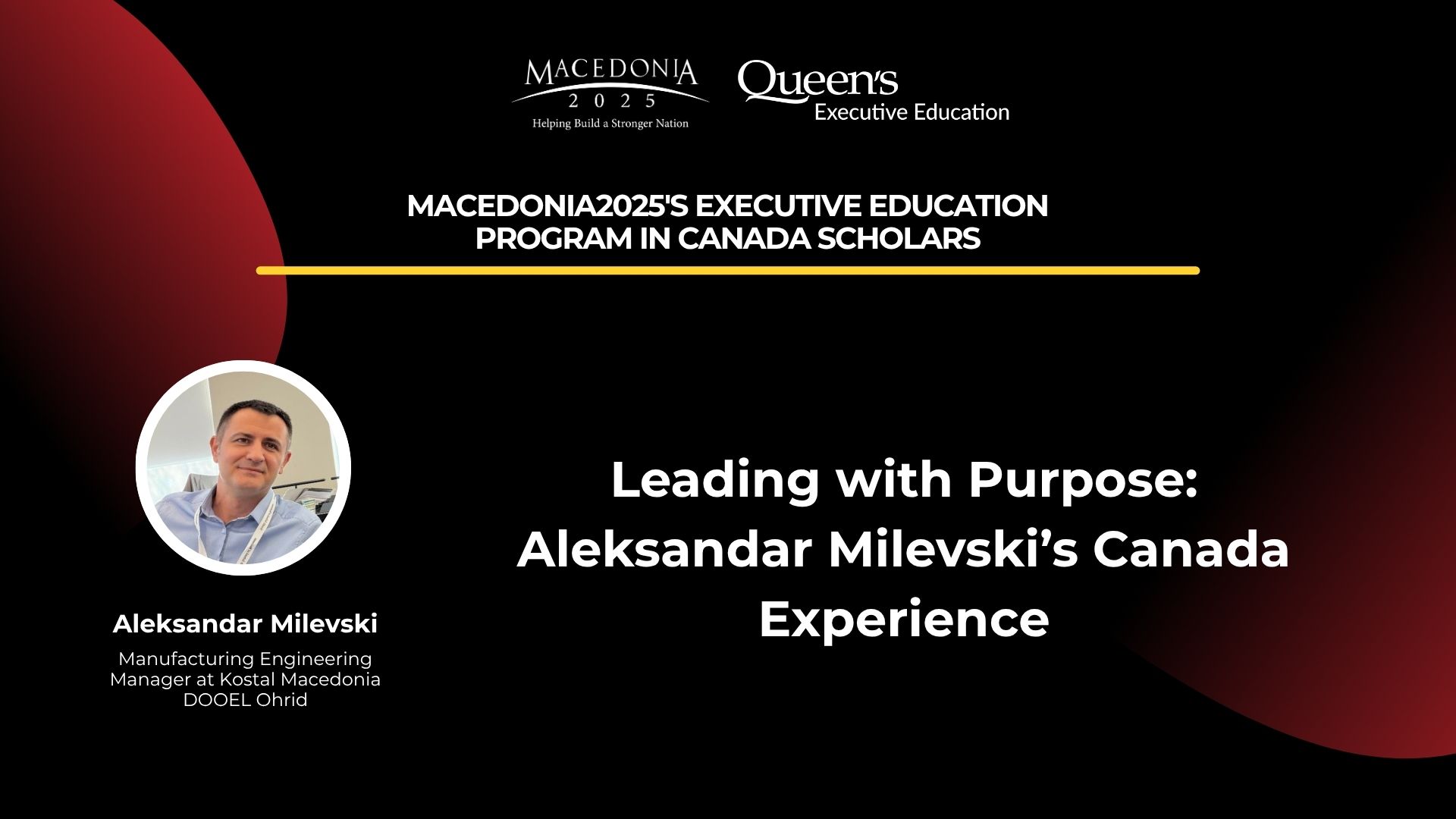
Leading with Purpose: Aleksandar Milevski’s Canada Experience
Through the Macedonia2025 Executive Education Program in Canada, talented Macedonian managers gain access to world-class executive education and meaningful exposure to the North American business environment.
Participants can attend either the Leadership Program or the Strategic Execution Program at Smith School of Business, Queen’s University. The academic experience is complemented by opportunities to connect with accomplished professionals, Canadian companies and members of the Macedonian community in Canada.
From June 8 to 12, 2026, scholarship recipient Aleksandar Milevski, Manufacturing Engineering Manager at KOSTAL Macedonia DOOEL Ohrid, participated in the Queen’s Leadership Program at Smith School of Business in Kingston, Canada. In this interview, he reflects on the leadership tools, practical exercises and professional connections that made the program a valuable personal and professional experience.
 |  |  |
How would you describe your overall experience in Canada?
It was a great privilege to participate in the Leadership Program at Queen’s Executive Education, Smith School of Business.
Because the program was supported by Macedonia2025, I had high expectations regarding both its professional content and the overall personal experience. I can confidently say that the program fully met those expectations.
From the moment we arrived in Canada, we felt welcomed and supported. Members of the Macedonia2025 Ambassadors Club, Iko and Aleksandar, took the time to meet us and join us for a walk along the lake.
It was a valuable opportunity to hear about their personal and professional experiences, their connection with the local Macedonian community and their lives in Canada. These conversations gave us an important introduction to the wider experience that awaited us.
What was your first impression of Queen’s University and Kingston?
On the second day, we travelled to Kingston and arrived at the Donald Gordon Conference Centre, where the Leadership Program was held.
The atmosphere and surroundings immediately reflected the long academic history and strong learning culture associated with Queen’s University. Spending time in such an environment created a sense that we were becoming part of an important tradition of education and professional development.
The city itself also contributed to the experience. During a guided tour of Kingston, we learned more about its history, important landmarks and historic architecture. This provided valuable context and made our stay more engaging beyond the formal classroom activities.
Which leadership lesson had the greatest personal impact on you?
The program began with a session on transformational and charismatic leadership led by Professor Julian Barling.
The session focused on applying the principles of transformational leadership and better understanding our personal leadership capabilities. One message particularly stayed with me: “What is the smallest thing you can do to make someone else’s life easier?”
It is a simple but powerful leadership principle that I plan to carry forward. Leadership is not always demonstrated through major decisions or dramatic actions. It can also be reflected in small, thoughtful steps that support colleagues, remove obstacles and create a better working environment.
How did the program help you develop greater self-awareness?
The next part of the program focused on building self-awareness and becoming a more self-aware leader, under the guidance of Peggy Baumgartner. We explored the 3 × 4 Coaching Model, which combines developmental approaches, coaching plays and practical coaching skills. It was particularly interesting for me to consider how this model could be applied within a real manufacturing environment.
The exercises offered a different perspective on working with employees, understanding their development needs and selecting the most appropriate leadership or coaching approach for each situation.
We also completed an individual TAIS assessment and received detailed personal feedback. This helped us better understand our leadership tendencies, behavioral patterns and potential areas for further development.
Which practical skills did you find most applicable to your professional role?
The sessions led by Monique Kavelaars on advanced coaching were especially practical. We explored how confidence, skills and knowledge influence employee performance, as well as how leaders should adapt their approach when working with people who demonstrate different behaviours or levels of capability.
Learning how to provide constructive feedback was particularly valuable. Feedback is essential in a manufacturing environment, where leaders must support continuous development while also maintaining clear expectations regarding quality, efficiency and performance.
The program also covered recognition and influence, active listening and techniques for clarifying understanding. Another useful tool was the confrontation map, which introduced four steps for leading productive conversations and resolving conflicts.
These are skills that can be applied directly in everyday management and team leadership.
What did you learn about managing performance and potential?
The formal learning program concluded with a model focused on productivity and potential.
We explored how different groups within an organization require different management approaches. Employees cannot all be led, motivated or developed in exactly the same way.
Some may need clearer guidance, others may require greater responsibility, while high-potential employees may benefit from additional development opportunities and more challenging assignments.
This reinforced the importance of understanding every individual within a team and adapting leadership practices to support both current performance and future growth.
How valuable were the group problem-solving sessions?
The team sessions held each evening were among the most valuable parts of the program. Every participant had an opportunity to present a real professional challenge to the group. The other participants then took on different roles, such as the person seeking clarification, a helper or an observer.
These sessions enabled us to see how professionals from different industries approached similar challenges. Although the organizations and sectors were very different, the discussions often led to the same conclusion: many business challenges are ultimately connected to people management.
The sessions showed us how valuable it can be to step outside our own industry perspective and listen to people who view the same issue from a completely different angle.
What stood out from your visit to Queen’s University with Professor Goce Andrevski?
On the final day, we had the privilege of visiting the Queen’s University campus with Professor Goce Andrevski.
It was inspiring to see the modern classrooms and the advanced technology integrated into the learning environment. We also learned how current developments, including artificial intelligence, are being incorporated into the educational experience.
Professor Andrevski’s enthusiasm for modern teaching methods and the development of future professionals was highly motivating. The visit offered us a closer look at how a leading university combines its long academic tradition with innovation and new technologies.
Which experiences outside the classroom were particularly memorable?
Our visit to the Thousand Islands with Professor Goce Andrevski was one of the most memorable experiences. Beyond the natural beauty of the area, the visit also reminded us of the importance of protecting the environment and developing greater awareness of our individual responsibility toward nature.
The combination of academic learning, cultural experiences and informal conversations made the program much richer. These activities allowed us to connect with one another outside the formal classroom and created lasting memories.
How would you describe your relationship with the other Macedonian participants?
As representatives from Macedonia, we were very warmly welcomed by the other participants in the program.
Although Orde Gjorgjioski, Kristijan Stojoski and I came from completely different industries, we immediately connected. Other participants frequently asked us whether we had known one another before arriving in Canada and were surprised to discover that we had met in person for the first time through the program.
Our professional connection quickly developed into a strong personal relationship. This was another important benefit of the experience - the opportunity to build valuable relationships not only with international professionals, but also with other Macedonian managers.
How did Macedonia2025 support you throughout the process?
I would like to express my sincere gratitude to Macedonia2025, and especially to Nena Manchev, for the excellent organization and support throughout the entire process.
The assistance began with guidance during the visa application process and continued through the travel preparations, communication, coordination and connections with members of the Macedonia2025 Ambassadors Club.
We were also supported in accessing job-shadowing opportunities, which added another practical dimension to the Canadian experience.
The team’s professionalism and dedication allowed us to focus fully on learning, networking and making the most of every opportunity available during the program.
Would you recommend the program to other business professionals?
I would highly recommend the program to business professionals from every industry.
It was a unique learning experience that provided practical tools for becoming a better leader, developing a high-performance organizational culture and incorporating high-performance expectations into everyday management practices.
The program demonstrated that leadership development is relevant regardless of the industry in which you work. Whether you lead teams in manufacturing, services, technology or another sector, the central challenges often remain the same: understanding people, communicating effectively, managing performance and helping others reach their potential.
I returned from Canada with new leadership tools, broader perspectives and valuable professional connections. Most importantly, I returned motivated to apply the lessons from the program within my own organization and everyday management practices.
The Macedonia2025 Executive Education Program in Canada supports the development of talented Macedonian managers by providing access to leading executive education courses at Smith School of Business, Queen’s University, as well as opportunities to connect with Canadian companies, professionals and members of the Macedonian diaspora.
Through its Leadership and Strategic Execution learning pathways, the program strengthens participants’ leadership capabilities, expands their international professional networks and equips them with knowledge and experiences they can apply within their organizations and communities in Macedonia.
Related News

OPEN CALL FOR SCHOLARSHIPS MACEDONIA2025 EXECUTIVE EDUCATION PROGRAM IN CANADA
Macedonia2025 invites accomplished Macedonian manage…
Discover More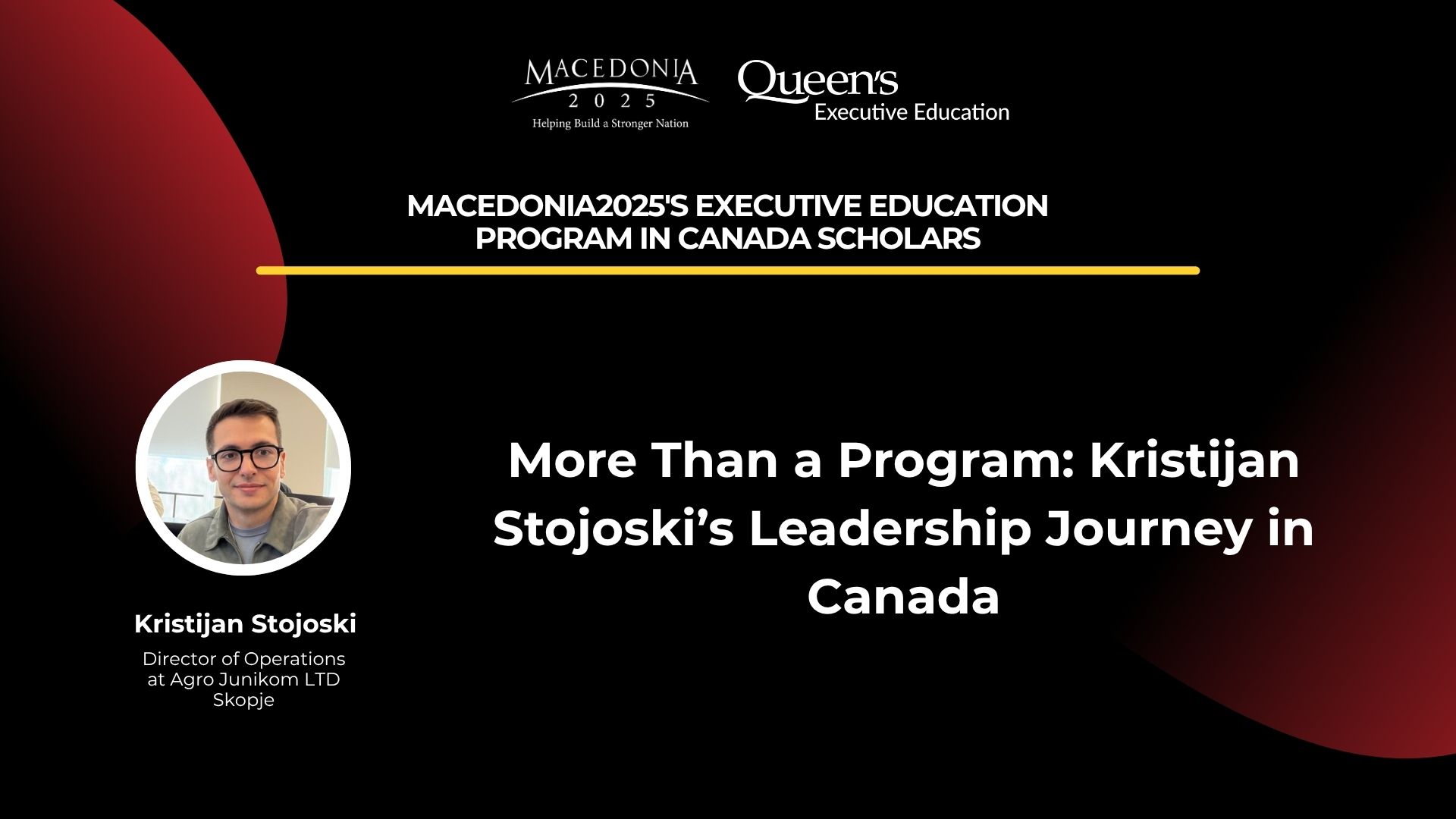
More Than a Program: Kristijan Stojoski’s Leadership Journey in Canada
For Kristijan Stojoski, Director of Operations at Ag…
Discover More
Returning from Canada with New Perspectives, Inspiration and Valuable Connections: Orde Gjorgjioski’s Leadership Journey
From June 8 to 12, 2026, scholarship recipient Orde …
Discover More